
Mains transformer for tube amplifiers


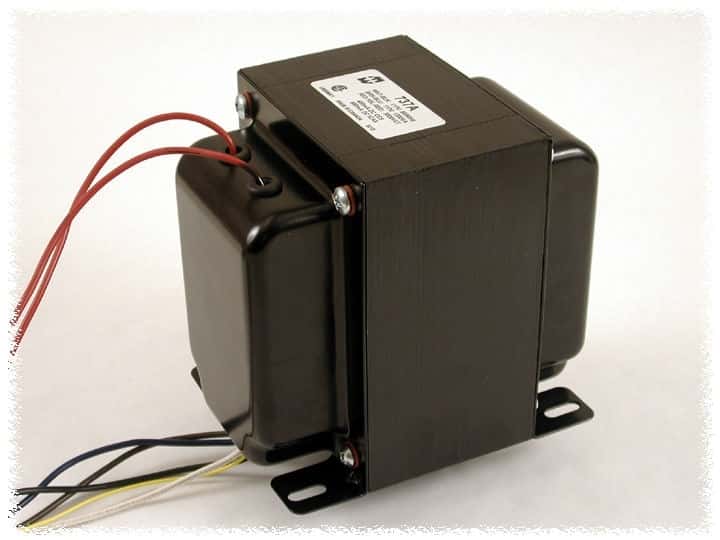

BTB Selection Guide for Hammond Power Transformers
This selection guide shows Hammond power transformers for tube amplifiers from the BTB range. The table is sorted by ascending high voltage and, where the high voltage is identical, additionally by VA rating.
The specified DC voltages are approximate values under rated load for a power supply with a 50uF capacitor, a filter choke with 100 Ohm RDC and a following 50uF capacitor. The calculation is based on full-wave rectification at 50Hz. For the DC voltage columns, the voltage drop of the respective rectifier as well as the load on the transformer winding were taken into account.
Hammond Power Transformers – Overview by High Voltage and VA Rating
| High voltage | Type | Power (VA) | Heater | Bias voltage | Rectifier | Tube rectification GZ34 | Silicon rectification |
|---|---|---|---|---|---|---|---|
| 100V-0-100V / 0.115A | 363AX | 32 | — | 50V | 5V / 2A | approx. 106VDC | approx. 118VDC |
| 125V-0-125V / 0.115A | 369AX | 40 | 6.3V / 2A | 50V | — | approx. 142VDC | approx. 153VDC |
| 225V-0-225V / 0.10A | 260E | 65 | 6.3V / 3A | — | 5V / 2A | approx. 287VDC | approx. 297VDC |
| 225V-0-225V / 0.15A | 369HX | 120 | 6.3V / 6A | 50V | 5V / 3A | approx. 275VDC | approx. 287VDC |
| 225V-0-225V / 0.30A | 369KX | 188 | 6.3V / 6A | 50V | 5V / 3A | — | approx. 257VDC |
| 240V-0-240V / 0.046A | 370X | 41 | 6.3V / 1.5A | 50V | 5V / 2A | approx. 321VDC | approx. 329VDC |
| 250V-0-250V / 0.085A | 260C | 65 | 6.3V / 2A | — | 5V / 2A | approx. 326VDC | approx. 336VDC |
| 275V-0-275V / 0.23A | 260G | 175 | 6.3V / 5A | — | 5V / 3A | approx. 327VDC | approx. 342VDC |
| 280V-0-280V / 0.069A | 371X | 63 | 6.3V / 2A | 50V | 5V / 2A | approx. 372VDC | approx. 381VDC |
| 300V-0-300V / 0.12A | 372BX | 98 | 6.3V / 3A | 50V | 5V / 2A | approx. 388VDC | approx. 399VDC |
| 300V-0-300V / 0.14A | 372DX | 127 | 6.3V / 4A | 50V | 5V / 3A | approx. 384VDC | approx. 396VDC |
| 300V-0-300V / 0.17A | 372FX | 150 | 6.3V / 5A | 50V | 5V / 3A | approx. 378VDC | approx. 391VDC |
| 300V-0-300V / 0.23A | 372HX | 191 | 6.3V / 6A | 50V | 5V / 3A | approx. 366VDC | approx. 381VDC |
| 300V-0-300V / 0.29A | 372JX | 243 | 6.3V / 8A | 50V | 5V / 4A | — | approx. 371VDC |
| 300V-0-300V / 0.58A | 372KX | 432 | 6.3V / 9A | 50V | 5V / 6A | — | approx. 351VDC |
| 300V-0-300V / 0.69A | 372LX | 520 | 6.3V / 12A | 50V | 5V / 6A | — | approx. 341VDC |
| 310V-0-310V / 0.08A | 372X | 75 | 6.3V / 2.4A | 50V | 5V / 2A | approx. 417VDC | approx. 426VDC |
| 320V-0-320V / 0.17A | 376X | 157 | 6.3V / 5A | 50V | 5V / 3A | approx. 406VDC | approx. 419VDC |
| 325V-0-325V / 46mA | 373AZ | 49 | 6.3V / 2A | 50V | 5V / 2A | approx. 441VDC | approx. 449VDC |
| 325V-0-325V / 0.17A | 260J | 152 | 6.3V / 4A | — | 5V / 2A | approx. 413VDC | approx. 426VDC |
| 325V-0-325V / 0.17A | 373CZ | 159 | 6.3V / 5A | 50V | 5V / 3A | approx. 413VDC | approx. 426VDC |
| 325V-0-325V / 0.23A | 260K | 197 | 6.3V / 5A | — | 5V / 3A | approx. 401VDC | approx. 416VDC |
| 325V-0-325V / 0.35A | 373EX | 311 | 6.3V / 9A | 50V | 5V / 6A | — | approx. 396VDC |
| 325V-0-325V / 0.46A | 373FX | 386 | 6.3V / 9A | 50V | 5V / 6A | — | approx. 388VDC |
| 350V-0-350V / 0.10A | 373DX | 101 | 6.3V / 3A | 50V | 5V / 2A | approx. 464VDC | approx. 474VDC |
| 350V-0-350V / 0.10A | 373DZ | 101 | 6.3V / 3A | 50V | 5V / 2A | approx. 464VDC | approx. 474VDC |
| 350V-0-350V / 0.13A | 373X | 125 | 6.3V / 4A | 50V | 5V / 2A | approx. 458VDC | approx. 469VDC |
| 350V-0-350V / 0.20A | 373BX | 187 | 6.3V / 5A | 50V | 5V / 3A | approx. 444VDC | approx. 458VDC |
| 350V-0-350V / 0.25A | 260M | 248 | 6.3V / 5A | — | 5V / 3A | approx. 436VDC | approx. 451VDC |
| 350V-0-350V / 0.40A | 373HX | 369 | 6.3V / 9A | 50V | 5V / 6A | — | approx. 436VDC |
| 350V-0-350V / 0.90A | 373JX | 710 | 6.3V / 12A | 50V | 5V / 6A | — | approx. 386VDC |
| 360V-0-360V / 0.138A | 374AX | 136 | 6.3V / 3.5A | 50V | 5V / 3A | approx. 473VDC | approx. 485VDC |
| 375V-0-375V / 0.127A | 374X | 141 | 6.3V / 5A | 50V | 5V / 3A | approx. 495VDC | approx. 507VDC |
| 375V-0-375V / 0.201A | 374BX | 200 | 6.3V / 6A | 50V | 5V / 3A | approx. 482VDC | approx. 496VDC |
| 400V-0-400V / 0.155A | 375X | 171 | 6.3V / 5A | 50V | 5V / 3A | approx. 521VDC | approx. 534VDC |
| 400V-0-400V / 0.2A | 378X | 237 | 6.3V / 6A | — | 5V / 3A | approx. 511VDC | approx. 525VDC |
| 400V-0-400V / 0.53A | 378CX | 465 | 6.3V / 6A | — | 5V / 6A | — | approx. 459VDC |
| 425V-0-425V / 0.17A | 379X | 193 | 6.3V / 5A | — | 5V / 3A | approx. 553VDC | approx. 566VDC |
| 500V-0-500V / 0.23A | 382X | 283 | 6.3V / 6A | — | 5V / 3A | approx. 645VDC | approx. 660VDC |
Power Transformers for Audio Tube Equipment – Selection, Specification and Replacement in Amplifier Builds
How do I calculate the expected DC voltage and ripple voltage with GZ34, reservoir capacitor, filter choke and smoothing capacitor?
UDC (V) = (1.414 × AC (V)) - 20V - (5 × Load current (mA) / Reservoir capacitor (uF)) - (Choke resistance (Ohm) × Load current (mA) / 1000)
Ubr ss (V) = (10 × Load current (mA) / Reservoir capacitor (uF)) / (2 × π × 100 × Choke (H) × (Smoothing capacitor (uF) / 1000000) × (UDC (V) / (Load current (mA) / 1000)))
Here, AC (V) means the voltage of one half winding, so with 300-0-300V, AC = 300V. Basis: full-wave rectification at 50Hz with GZ34.
Example: Hammond 372FX, 50uF, 50uF, 193G 10H / 102 Ohm, 100mA
UDC = (1.414 × 300V) - 20V - (5 × 100mA / 50uF) - (102 Ohm × 100mA / 1000) = approx. 384V
Ubr ss = (10 × 100mA / 50uF) / (2 × π × 100 × 10H × (50uF / 1000000) × (384V / (100mA / 1000))) = approx. 0.1Vss
What are power transformers for audio tube equipment?
Power transformers for audio tube equipment convert mains voltage into the required secondary voltages for high voltage (B+), heaters and auxiliary voltages. They are the central power supply component in tube amplifiers, preamps and studio devices because they enable safe and stable operation of the complete circuit.
In audio applications, they influence not only the power supply itself, but also hum behaviour, thermal reserve and long-term reliability.
What is the role of a power transformer in a tube amplifier?
A power transformer provides the required voltages for plate supply and heater filaments and therefore defines the operating point of the tube stages. Typical examples are heater voltages such as 6.3V or 12.6V as well as high-voltage windings for rectifier and filter stages.
Especially in high-end audio, it is important that the transformer remains stable under load and offers sufficient reserve for dynamic signal peaks.
Which technical data are most important when selecting one?
The key factors are secondary voltages under real load, permissible current ratings, insulation class and the thermal design of the core. Mechanical dimensions, mounting style and connection concept are equally important, since power transformers for audio tube equipment must be selected according to construction type and specification.
For developers and OEM users, reproducibility of values across series and batches also matters.
Which designs and specifications are available?
Power transformers differ depending on core construction, winding design and shielding against magnetic stray fields. These factors affect installation, induced hum in sensitive preamp stages and overall low-noise performance. We stock EI-core, toroidal, cut-core and C-core Lundahl power transformers.
For repair and new builds, it is therefore important not only to compare the voltage, but also the complete specification of the original transformer.
When is replacement necessary in service cases?
Replacement is necessary when winding interruptions, short circuits, insulation damage or thermal overload occur. Power transformers are among the most important replacement parts because a failure often prevents the entire amplifier from operating.
Before installation, service technicians typically check winding resistances, voltages under load and proper grounding in order to avoid consequential damage to tubes or power supply components.
How important is compatibility with tubes and circuits?
Compatibility means that heater currents, high-voltage values and auxiliary windings exactly match the tube complement and the power supply design. Many tubes are interchangeable within their family, but exceptions regarding heater data and current demand must be considered.
An incorrectly dimensioned power transformer can cause undervoltage, overheating or increased hum and shorten tube life.
How important are availability and delivery in Germany and Europe?
For Germany and Europe, reliable availability is important because tube amplifiers are often used long term and serviced regularly. Especially in audio service, fast replacement deliveries are essential to carry out repairs reliably.
International delivery is relevant for export equipment, globally supported service cases and audio projects outside Europe.
Who are power transformers particularly relevant for?
End customers benefit from selection guides for suitable voltages, designs and reserves in hi-fi and studio applications. Professional users, service workshops and OEM companies also look for documented specifications, consistent quality and long-term availability.
This makes power transformers for audio tube equipment a key component for new builds, repairs and the sustainable operation of high-quality tube technology.