
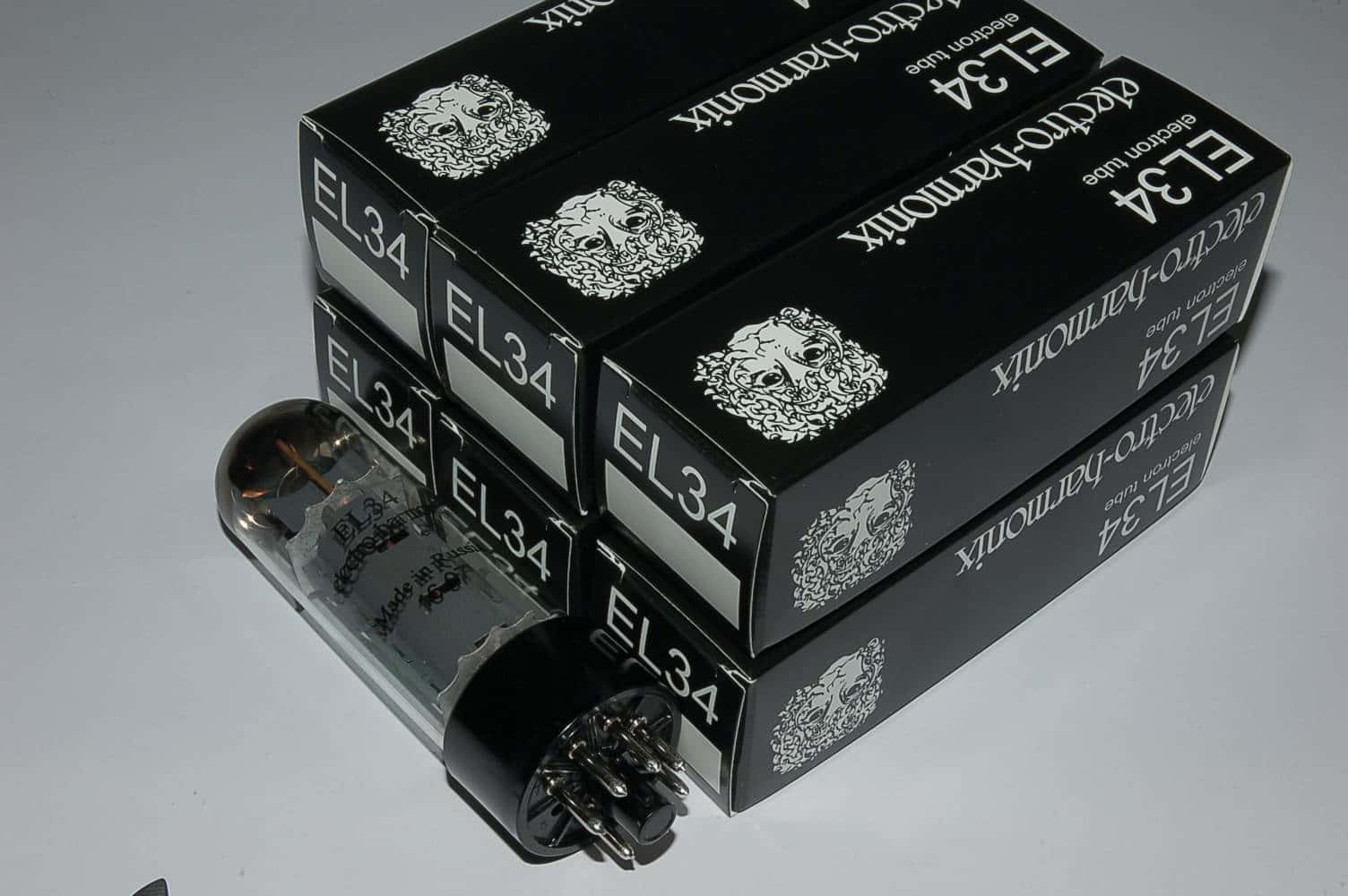
octal power tubes EL34, E34L, 6CA7, KT77, 6P27C, EL34-2 Unless otherwise specified, these are matched in-house at BTB with an anode voltage of 450 volts

Currently sold out

Delivery time: ca. 1 - 5 days

Delivery time: ca. 1 - 5 days

Delivery time: ca. 1 - 5 days

Delivery time: ca. 1 - 5 days

Delivery time: ca. 1 - 5 days

Delivery time: ca. 1 - 3 days

Delivery time: ca. 1 - 5 days

Delivery time: ca. 1 - 5 days

Delivery time: ca. 1 - 5 days

Delivery time: ca. 1 - 5 days

Delivery time: ca. 1 - 5 days

Delivery time: ca. 1 - 5 days

Delivery time: ca. 1 - 5 days

Delivery time: ca. 1 - 5 days

Delivery time: ca. 1 - 5 days

Delivery time: ca. 1 - 5 days

Delivery time: ca. 1 - 5 days

Delivery time: ca. 1 - 5 days

Delivery time: ca. 1 - 5 days
Delivery time: ca. 1 - 5 days

Delivery time: ca. 1 - 3 days
Delivery time: ca. 1 - 5 days

Delivery time: ca. 1 - 5 days
EL34, 6CA7 & KT77 Output Tubes – Selection, Replacement and Hand-Selected Sets
What are output tubes and what are they used for?
Output tubes (power tubes) are vacuum tubes used in the power stage of an amplifier, where they amplify the audio signal to the required output power. They have a decisive influence on tone, volume, dynamics and, in guitar amplifiers, headroom as well as the distortion characteristics of the power stage.
EL34, 6CA7 and KT77 tubes are mainly used in guitar amplifiers and in many push-pull hi-fi power amplifiers. For technicians and service workshops, they are considered typical wear parts, as thermal stress and aging affect both sound quality and operational reliability.
What are the differences between EL34, 6CA7 and KT77?
EL34, 6CA7 and KT77 belong to a compatible tube family designed for similar output stage circuits, but they differ in construction and electrical characteristics. These differences influence bass control, midrange response, dynamics and headroom at high output levels.
The EL34 is regarded as a classic in European tube amplifier design, known for its pronounced midrange and early compression. The 6CA7 is often described as having tighter bass and higher robustness, while the KT77 typically offers greater linearity and dynamics. In hi-fi applications, the operating mode such as Class A or Class AB, as well as sonic performance at very low signal levels, also play an important role.
How do I choose the right output tube?
The selection depends on the circuit design, permissible power dissipation and the intended bias setting. It is essential that the amplifier explicitly supports the use of EL34, 6CA7 or KT77 tubes.
In many EL34-based designs, 6CA7 or KT77 tubes can be used as alternatives, provided that the bias current is correctly adjusted. Guitarists often focus on dynamics and playing feel, while hi-fi users prioritize neutrality and long-term stability. For B2B customers, reproducible measurement data and long-term availability are key factors. For meaningful advice, it is often helpful to send an inquiry email outlining specific requirements.
Why are hand-selected sets as pairs, quartets, sextets or octets useful?
Hand-selected tubes are measured according to their electrical characteristics and grouped into closely matched sets. This optimizes the sound quality of audio components and the tonal performance for guitarists.
Depending on the amplifier, pairs, quartets, sextets or octets are required to optimize stereo imaging in hi-fi systems and to minimize distortion (transformer symmetry). Especially in push-pull circuits and high-quality hi-fi or high-end power amplifiers, proper matching ensures the best sonic performance and reduced hum.
What should be considered when replacing tubes and regarding availability?
When replacing output tubes, correct bias adjustment is essential to avoid overload or sonic degradation. In addition, adjacent components such as tube sockets and coupling capacitors should be checked.
For end customers in Germany and Europe, having a reliable point of contact is particularly important, while professional users primarily focus on competitive pricing, short delivery routes and second-source options.